
CFHS code : AG273
Parish : St Andrew the Great
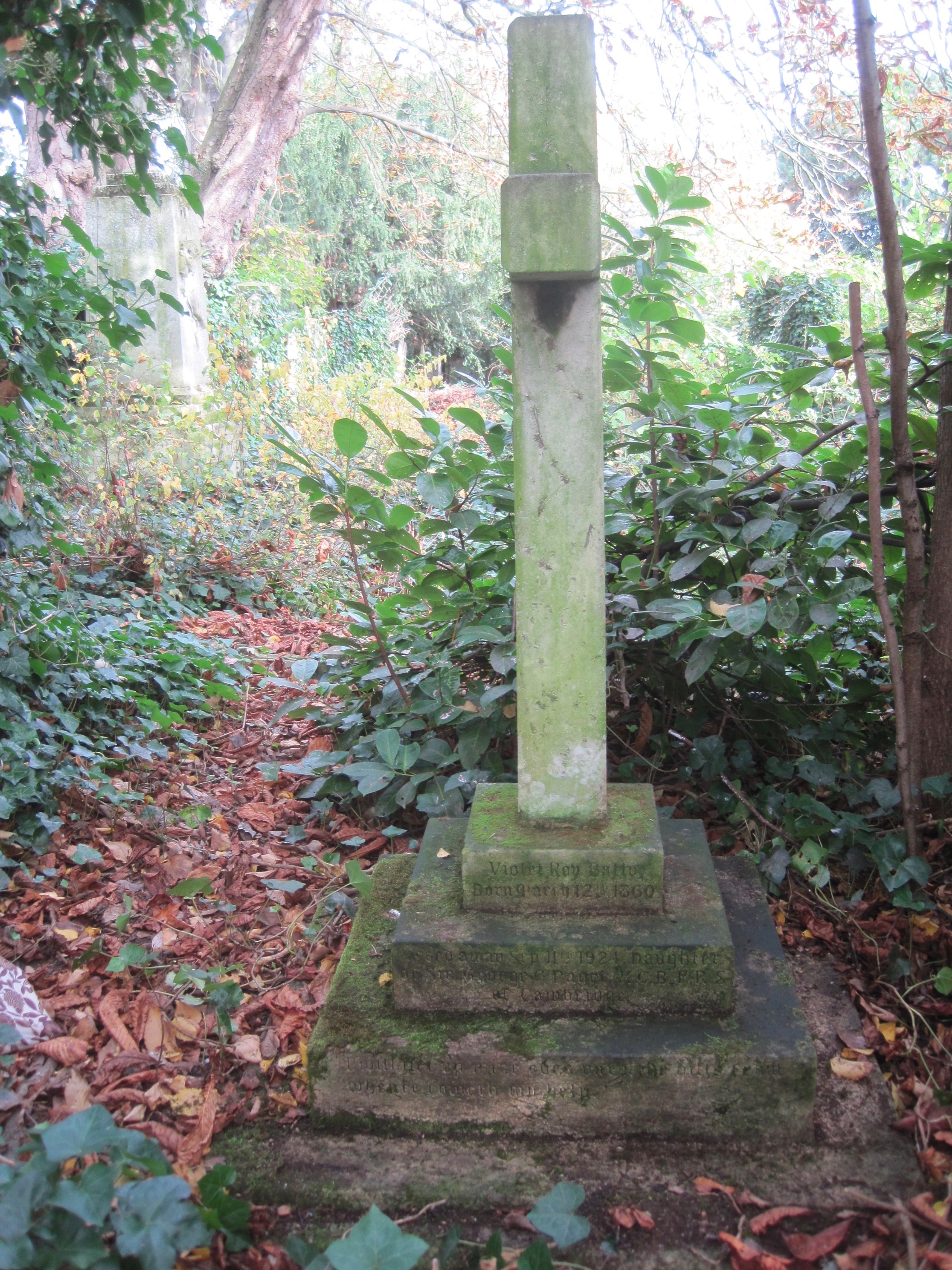
Inscription : In Tenderest MO CHARLES S ROY MA MD FRS first Professor of Pathology in the University of Cambridge born in Arbroath Jan 27th 1854 d Oct 4th 1897 VIOLET ROY BATTY b March 12th 1860 d Sep 11th 1924 daughter of Sir GEORGE – PAGET KCB FRS of Cambridge
Monument : Stone cross
Above information from Cambridge Family History Society Survey
Lat Lon : 52.20305, 0.13640949 – click here for location
Monument
This stone cross is situated close to the west wall in the parish area of St Andrew the Great and is liable to be covered in vegetation. The inscription is still legible.
Inscription
east face
In Tenderest Memory of CHARLES S ROY MA MD FRS
First Professor of Pathology in the University of Cambridge
Born in Arbroath Jan. 27th 1854 d Oct. 4th 1897
“O rest in the Lord, wait patiently for him, and He will give thee thy Heart’s desires.”
south face
VIOLET ROY BATTY born March 12th 1860 passed away Sep. 11th 1924.
Daughter of Sir George-Paget KCB FRS of Cambridge.
“I will lift up mine eyes unto the hills from whence cometh my help.”
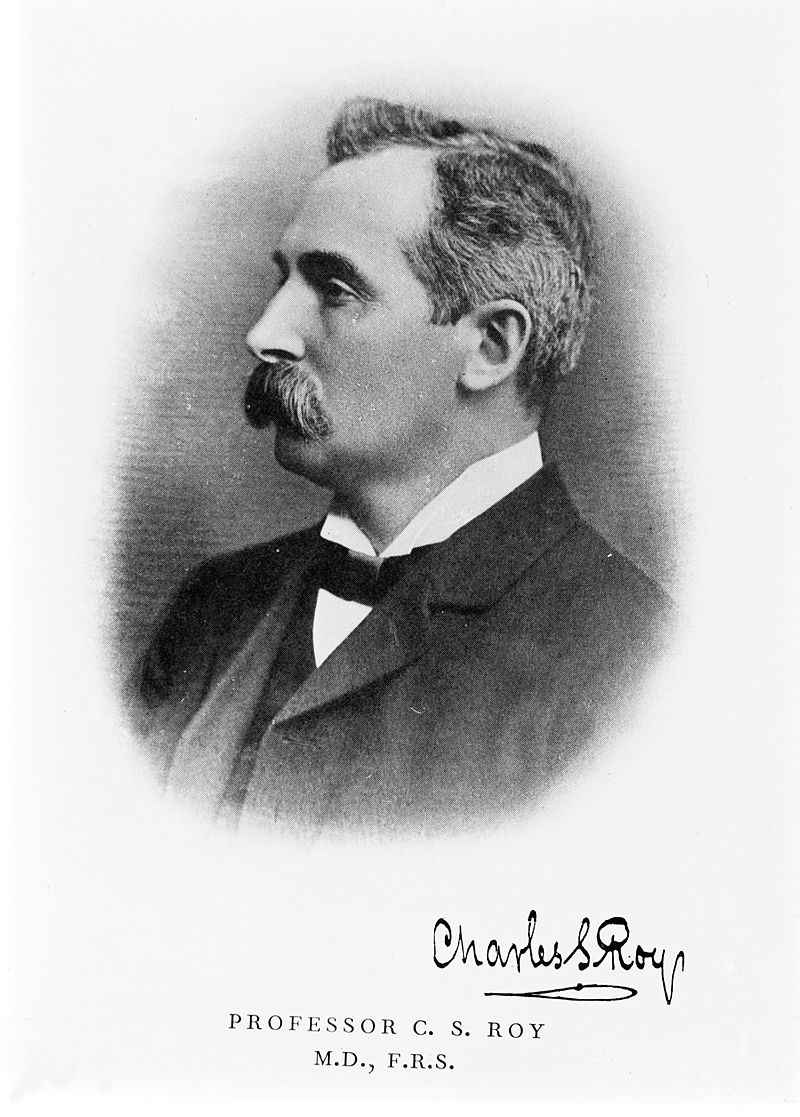
Charles Smart Roy (27 January 1854 – 4 October 1897)

Charles was born in Arbroath, the son of Adam and Elizabeth (née Smart) Roy. His father was a ship owner, coal merchant and painter and Charles attended the High School in Arborath. He studied Medicine at Edinburgh University, graduating in 1875. He served briefly as a doctor at the Edinburgh Royal Infirmary before moving to London where he worked at the Brown Insitution in the area of pathological research. His research focussed on ‘the pathological anatomy of Epizootic Pleuro-pneumonia’. When the Serbian-Ottoman wars broke out in 1876 he worked for the Turkish Army and was chief medical officer at Yanina. Whilst there and ‘after the battle of Yenikei an incident occurred creditable to his pluck and decision. A young Pole was brought in so severely wounded in the leg that Dr. Roy considered amputation necessary, but from motives of jelaousy the Turkish doctors objected till the sanction of the Governor was obtained. Dr. Roy threatened to go to the Commander-in-Chief and report their neglect and mismanagement, and prepared to leave. The Turks, in terror, implored him to remain, and ever after Dr. Roy succeeded in securing satisfactory arrangements’.
After his army service he returned to London to work briefly at the Brown Institute. In November 1877 he went to work for Professor E. du Bois Reymond in Berlin, before being made assistant at the Physiological Laboratory in Strasburg, where he worked for a year, conducting investigations on the circulation ‘especially on the pulse and the elasticity of the walls of the arteries’. He subsequently worked for Professor Cohnheim at the Pathological Insitute in Leipzig.
In November 1879 he was ‘elected to the George Henry Lewes Studentship’ at Cambridge University. The scholarship had been established that year by the novelist George Eliot, in memory of her friend (and lover) Geoge Henry Lewes and was for the support of phsyiology. Charles worked in Professor Michael Foster’s laboratory in Cambridge and was ‘occupied with researches on physiology and pathology of the heart, spleen and kidney’. He was sent to Argentina to ‘make investigations on a widespread and fatal disease whose nature was unknown, but which was found to be anthrax’. In May 1884 he was elected to the newly founded role of Professor of Pathology at Cambridge University. The role paid £800 per annum ‘subject to the condition that the Professor is not allowed to practise’. He became a member of Trinity College, and the University awarded him an M.A. degree. He was particular noted for his investigations of the function of the spleen, and contributions to the Quain’s Dictionary of Medicine. Furthermore Charles Roy invented several pieces of apparatus, including one which tested the blood pressure of both humans and animals without the need of breaking the skin to do so.
Charles married Violet Paget on 5 July 1887 at the Parish church in Dwygyfylchi, Caenarvonshire and they lived at 2 Wollaston Road (1891) and then 27 St. Andrew’s Street. In May 1889 Charles was summonsed to court for ‘riding a tricycle on the footway of Parkside’ with no lights in the early hours of the morning. His defence was that the road had been freshly laid with stones, so therefore was unsuitable for cycling on and furthermore there were no people walking on the footpath at that time of the night. ‘The Chairman said that the Bench were of the opinion that the offence was only aggravated by the defendant persisting in riding on the footpath. It was no excuse to say that there were no passengers about. The decision of the Bench was that he should be fined 20s and costs. – The defendant: Very good’.
Charles Roy was ill for the last two years of his life and ‘had a most serious illness and was compelled to give up work, the duties of his office being discharged by a duputy, Dr. Kanthack‘. It was reported later that he had ‘had an attack of influenza from the effects of which he never quite recovered’. The Abroath Herald speculated that the origin of his poor health was due to an attack of cholera whilst on a work trip to Spain. He died at home aged 43 years old and his funeral was held on 8 October. A service was held at Trinity College Chapel before interment at Mill Road Cemetery – the service was conducted by Rev. Dr. Butler, Master of Trinity College. His death was reported in national newpapers with the Dundee Courier running a headline ‘Death of Professor Roy – A distinguised Arbroath Native’. The newspaper reported ‘the deceased Professor wrote his brother about a fortnight ago to take a house for him in Arbroath, thinking his native air would do him good, and the house was accordingly taken in Princess Street for him and his wife, who were to be in Arbroath in November’. Professor McKendrick described Charles Roy as ‘a man of clear and sharp intelligence, of much insight and unwearied patience. He had much enthusiasm for his work, and a keen appreciation of the aims of scientific labour’.
Violet Emma Roy Batty (née Paget) (1860-1924)
Violet and her twin sister Rose (1860-1951) were the seventh and eighth children born to George Edward and Clara Paget. She and Rose were baptised in the parish of Mary the Less on April 13th 1860. She was brought up at 2 St Peter’s Terrace which is very close to the original Addenbrookes hospital building on Trumpington Street, Cambridge and married Charles Roy when she was 27 years old. When Charles died unexpectedly and suddenly during an epileptic fit in 1897 she was left with many debts. She was befriended by Mary Kingsley and for some time worked as a kind of personal secretary for her. She married James Henley Batty (1868-1946) on 17 December 1901 at St. Peter’s Church, Southborough, Kent. Batty was a trader/merchant, who dealt extensively with the Gold Coast countries in Africa and Mary Kingsley had met him on her first voyage to West Africa. James was later described as a ‘man of rare gifts, of a far-sighted and adventurous spirit’. The couple lived at 40 Harley House, Regent’s Park, but by 1911 Violet’s health was noted as ‘moderate’. In 1917 James bought the Cedar’s Estate, near Chorley Wood, but it was said that Violet did not like the house and they moved to the Meeting House Farm, renaming it ‘The Manor House’. The Cedars mansion and 50 acres of land were given by the Batty’s to the RNIB, and converted to a school for blind girls.
Violet died on 11 September 1924 at the Manor House and she was cremated at Golder’s Green on 16 September with a memorial service the following day at Chorley Wood Parish Church. The funeral notice stated that ‘she desired to send cordial greetings to all her friends’. The Buckingham Examiner reported ‘she had passed from home to home, contemplating the journey with equanimity and remembering her friends at the last….the late Mrs. Batty faced the parting of the ways with just such calmness and steadfastness and her end was peace’. At the memorial service the Vicar ‘spoke of the wonderful personality and lovable nature of the one they had lost. He paid a warm tribute to her strong will and large gentle heart. Heaven was the richer for such a soul as hers’. Her ashes were scattered in Cambridge with her first husband.
James Batty married Mary (known as Molly) Simpson (1873-1968) in 1926.
Violet’s twin married Sir Joseph John Thomson, and was known as Lady Rose Elizabeth Thomson. Joseph was Professor of Experimental Physics at Cambridge University and Rose was buried in Westminster Abbey. Joseph and Rose’s son Sir George Paget Thomson was an award-winning physicist, Nobel prize winner, and Master of Corpus Christi College.
Sources:
Photograph of Charles Roy: unknown, modified by Kuebi = Armin Kübelbeck – Raymond Williamson: A Photograph of Sir Charles Sherrington and Professor Charles Smart Roy and Three Letters by Sir Charles Sherrington. Med Hist. 1959 January; 3(1): pp. 79. image treated by Kuebi = Armin Kübelbeck
The Scotsman Friday 12th September 1924
Katherine Frank: Mary Kingsley: A Voyager Out
Ancestry
Newspaper archives
by Mary Naylor, Caro Wilson and Claire Martinsen
[If you have any information about this family, please contact us at Friendsofmillroadcemetery@gmail.com]