
CFHS code : MG53
Parish : St Mary the Great
Inscription : In Loving Memory of JAMES PARNELL d February 28th 1919 aged 81 also of his wife ELIZABETH d November 24th 1865 aged 27 and ELIZA his wife d December 18th 1920 aged 90 also EMILY daughter of JAMES and ELIZABETH d May 28th 1936 aged 72
Monument : Headstone/Kerb stones
Above information from Cambridge Family History Society Survey
Lat Lon : 52.202245, 0.13761486 – click here for location
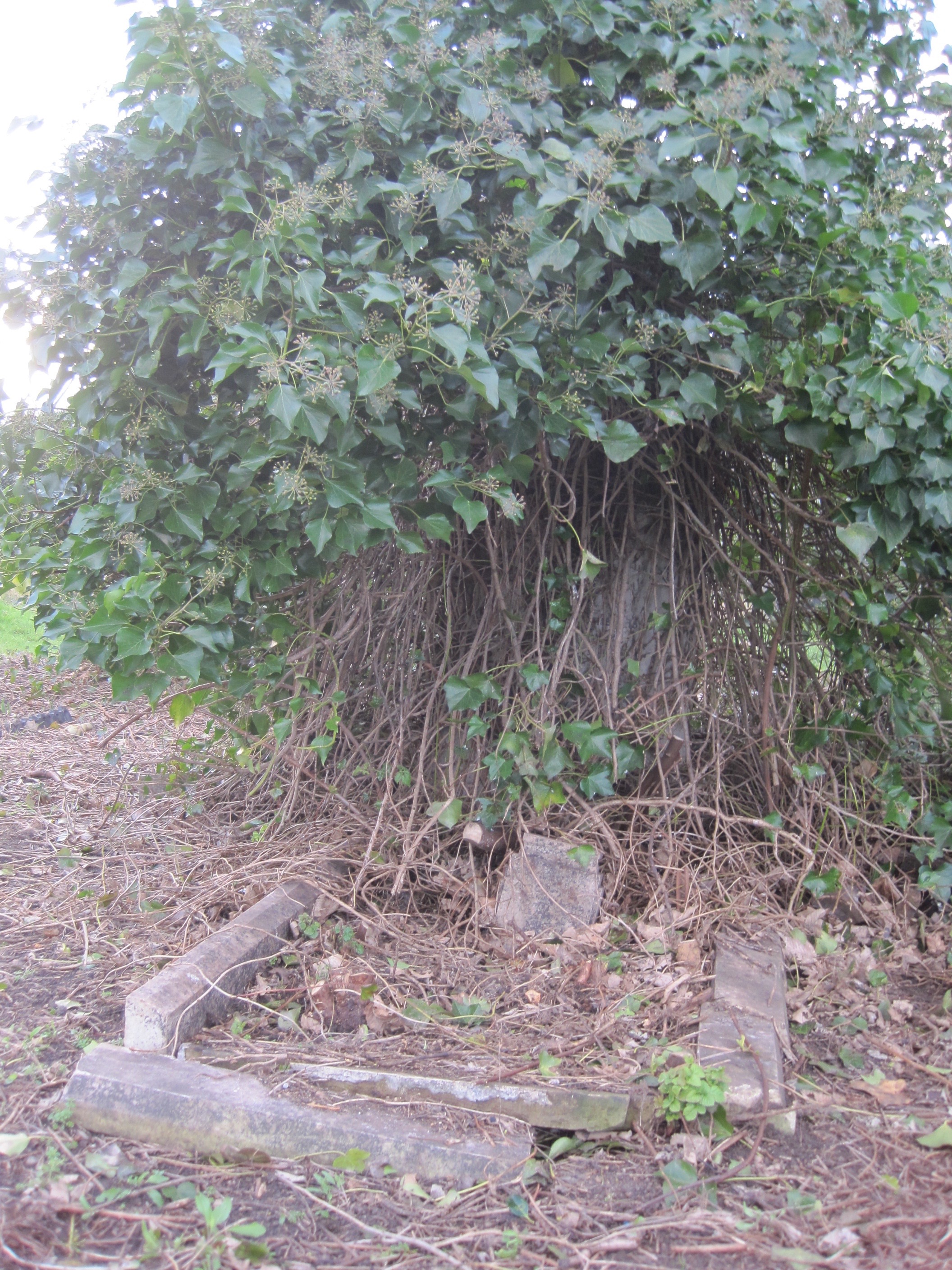
Monument
This headstone with kerbstones and flower holder stands10 rows east of the central path, towards the north of the parish area of Mary the Great. For many years it was hidden by ivy but partial clearance in 2023 revealed that at least some of the inscription of metal letters is intact.
Inscription
In Loving Memory of JAMES PARNELL who died February 28th 1919 aged 81 years
Also of his wife ELIZABETH who died November 24th 1865 aged 27
And ELIZA his wife d December 18th 1920 aged 90 years
At Rest
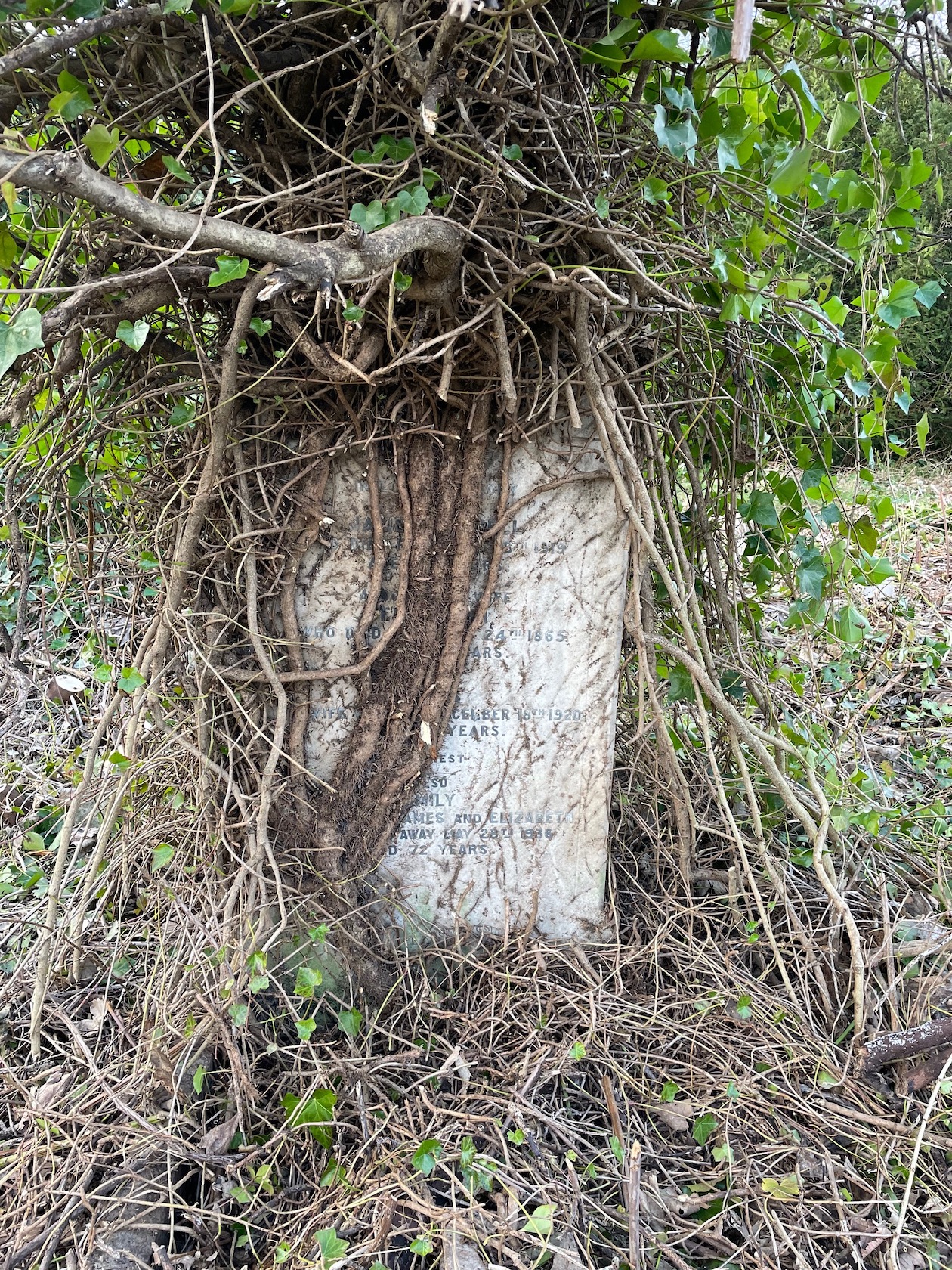
Also EMILY daughter of JAMES and ELIZABETH passed away May 28th 1936 aged 72 years
James Parnell (1837 – 28 February 1919)
James was born in Elsworth, the illegitimate son of Elizabeth Parnell (1814-1900) and was baptised on 9 July 1837. His mother married agricultural labourer George Hull in October 1840 and James was raised at George’s son, together with his five half-siblings in the village of Bourn. By the age of 14, James was also working as an agricultural labourer. In 1861 he was working as a police constable and lodging with the Muncey family at 21 Bradmore Street. He married Elizabeth Saunders on 12 November 1862 in Bourn and they had one daughter: Emily (1863-1936). The family lived at 11 Brandon Place, and after James was widowed in November 1865, he married Eliza Dant on 25 June 1867 at St. Clements Church.
James was a police constable from at least 1860 to 1866 and as part of his role appeared as a court witness many times, mainly related to arrests due to being drunk in the streets. In June 1862 he charged Charles Webb with being drunk and creating a disturbance. Charles was sent to goal for 10 days with hard labour. In March 1865 he charged ‘Mary Gordon, a tramp with being drunk and begging in Mr Watson’s shop, Petty Cury’. The case was discharged, on condition that Mary and her husband leave Cambridge at once. The same month, James charged Thomas Brown [also a tramp] with begging in Malcolm Street. Thomas had been cautioned before being arrested, and told the court that he ‘had been…the biggest part of his time since Christmas in Huntingdon goal’. He was sentenced to 21 days imprisonment. In October 1865, Robert Dudgun was charged with being ‘drunk and utterly incapable in Bridge Street’, however at court Robert expressed contrition and was therefore discharged. Newpapers show that James played cricket for Cambridge police division.
It is not known when James left the police, but by 1881 was working as a porter at Trinity College. He was living at 52 Covent Garden with Eliza and daughter Emily. He and Eliza later moved to live at 2 Covent Garden (at least 1891 onwards). James was witness to a fire in March 1895 where Augusta Robinson and Sarah Shallow died, and gave evidence at court. He had retired by 1911, and died at home aged 82 years old. His funeral was held on 4 March 1919 and the Cambridge Independent Press printed a short obituary. It noted that he had worked at Trinity College for over 40 years, and was ‘one of the earliest members of the Cambridge Co-operative Society and for a great number of years was chairman of the Co-operative Education Committee. He was a keen Liberal in politics. Mr Parnell attended St. Paul’s Church and was also greatly interested in the men’s services at Holy Trinity’. Representatives from both Trinity College and the Co-operative Society attended the funeral, although his widow Eliza was too unwell.
Elizabeth Parnell (née Saunders) (1838 – 24 November 1865)
Elizabeth was born in Bourn and was the daughter of John and Mary. She grew up in the village where her father was an agricultural labourer. She was working as a dressmaker, before marrying James Parnell and died at 11 Brandon Place aged 27 years old.
Eliza Parnell (née Dant) (1830 – 18 December 1920)
Eliza was the eldest daughter of David (1808-1892) and Catherine (née Leake) (1808-1861). She was borin in St. Ives, but had moved to Cambridge by 1861 where her father was a ferryman, later runing Dant’s Ferry at Chesterton. The family lived at Quyside and in 1861, Eliza was living at home and working as a cook. In July 1864 she was charged by Ann Hutt with using bad language. The court heard that Eliza had approached Ann in Bridge Street and used ‘very offensive language…Two young men in the employ of Mr. Dant, waterman stated that they were talking with the complainant when their mistress, Miss Dant, came up and said one ‘she said why are you talking to that strumpet?’ while the other in his evidence said ‘Why are you talking to that trump’. The defendant said ‘strumpet’ was the word she used’. She was fined 1s and expenses.
She married widower James Parnell in 1867 and died at 2 Covent Garden. She was buried at Mill Road Cemetery on 21 December. Newspapers reported ‘Mrs Parnell was greatly respected and esteemed in Petersfield ward and a large number of neighbours and friends assembled at the cemetery to pay their last respects to one they have known so long’.
Emily Parnell (1863 – 28 May 1936)
Emily was born in Cambridge and baptised in Bourn on 4 October 1863. By the age of 17 (1881) she was living at Covent Garden and working as a pupil teacher. She taught in Waterbeach (1891) before moving to be Headmistress at Mawneys Road Infants School, Romford, Essex (1896-1915). In March 1903 she was appointed to the Essex Technical Education Committee for elementary teachers. Two teachers from the county were elected, and it was specified that there had to be one male appointment and one female. Emily was the unanimous choice for her role and was a member of the Committee for ten years before stepping down. She gave a speech in 1913 where she talked of the difficulty of juggling roles as a ‘clerk for her school, as representative on the Education Committee, as organiser of her school and as a teacher. She felt the duties were rather manifold. She was clerk because there was so much clerical work to do for teachers that it pressed very hardly upon them. The clerical work had to be taken first and the teaching had to be taken last, instead of first. In the future she hoped to be able to give more time to teaching. The clerical work for teachers had geatly increased, but the staffs [sic] of the schools had not increased so much’. She was presented with an illuminated address and a ‘ring set with diamonds and sapphires’ when she retired from the Education Committee.
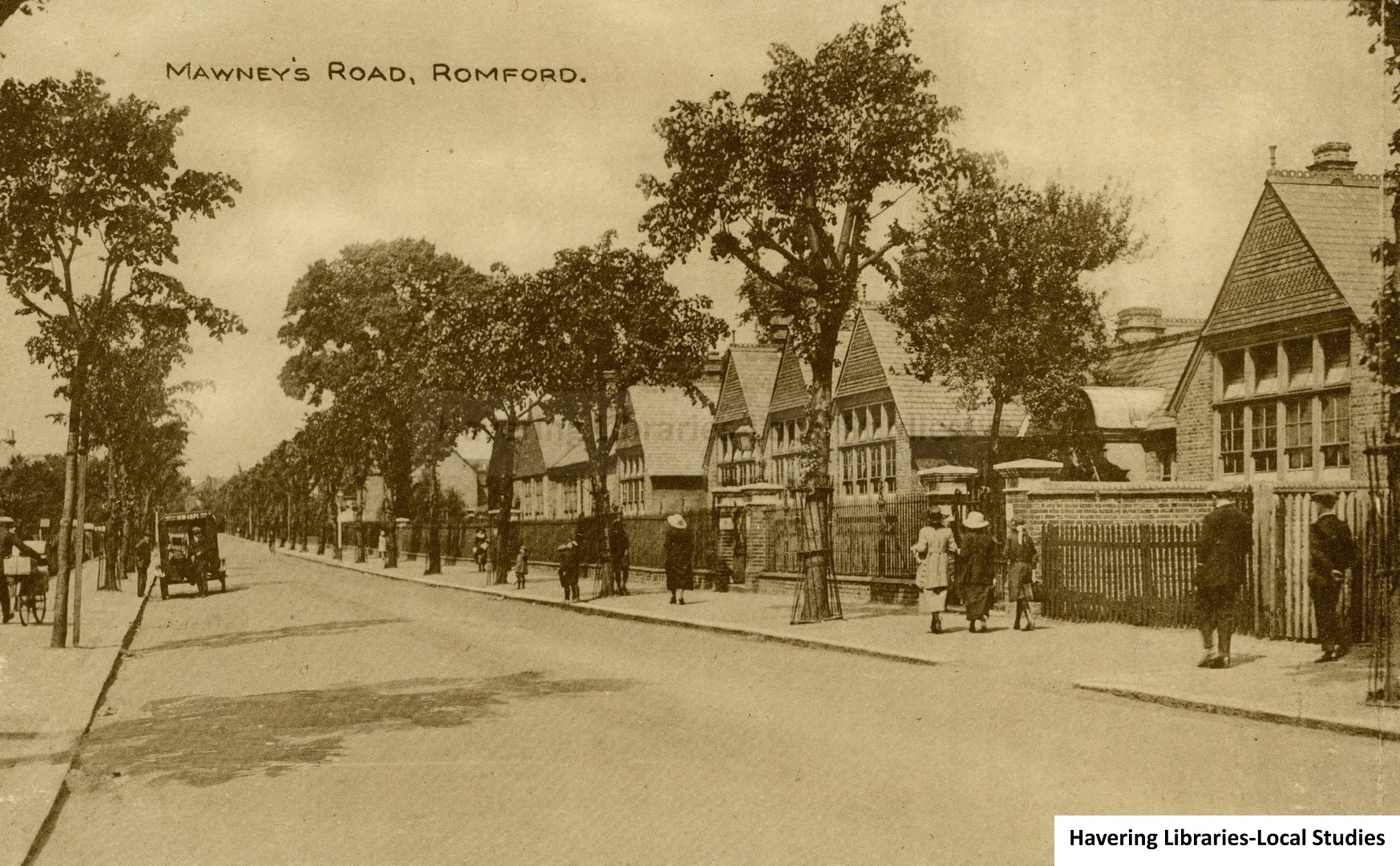
Emily retired in February 1915, after having been headmistress of Mawneys Road Infants School since it was opened on 31st August 1896. She left the ‘profession at the imperative call of family duty’ – to care for her aging father and step-mother in Cambridge. At the 1915 school prize giving she was described as ‘a very efficient headmistress’ and she told the audience that it ‘was a time of sadness to a certain extent, because she did not like to say good-bye, but she thanked them all very heartily for their co-operation and kindness’.
In Cambridge she was involved with the ‘National Kitchen, Mill Road, Romsey town and Sturton town’ (1918) and the Children’s Fete, organised by the Cambridge Co-operative Society (August 1919). The Fete was to celebrate 50 years of the Cambridge Co-operative Society and nearly 4,000 children attended the celebrations on Parker’s Piece. It began at 2.30pm and consisted of sports, a Punch and Judy show, daylight fireworks, parachutes, balloons and bands before ‘at 7 o’clock parents were admitted to watch boot cleaning, metal polishing and washing exhibitions’. Emily sat on the Education Committee for the Co-operative Society. She continued to live at 2 Covent Garden after her parents’ deaths, and died ‘suddenly’ at Tring Road, Felixstowe aged 72 years old.
Emily left an estate valued at £8,167, 7s and 10d. The details of her will were publised in August 1936. She left £25 to the nurse who attended her when she died, £50 to Florence Cross and Ellen Corder, £25 to seventeen individuals and the residue of the estate divided between: Addenbrooke’s Hospital, The Cottage Hospital, Romford, The National Union of Teachers’ Orphanage for Girls, Sheffield, The National Union of Teachers’ Orphanage for Boys, Sydenham and the Hospital for Incurables, Streatham.
Sources:
Ancestry
Newspaper archives
by Claire Martinsen
[If you have any information about this family, please contact us at Friendsofmillroadcemetery@gmail.com]