
CFHS code : AL549
Parish : St Andrew the Less
Inscription : IBMO WILLIAM BLACKWELL d April 5 1862 aged 50 also of ELIZA wife of the above d January 24 1882 aged 68 this stone was erected by WILLIAM & SUSANNAH their loving children
Monument : Headstone
Above information from Cambridge Family History Society Survey
Monument
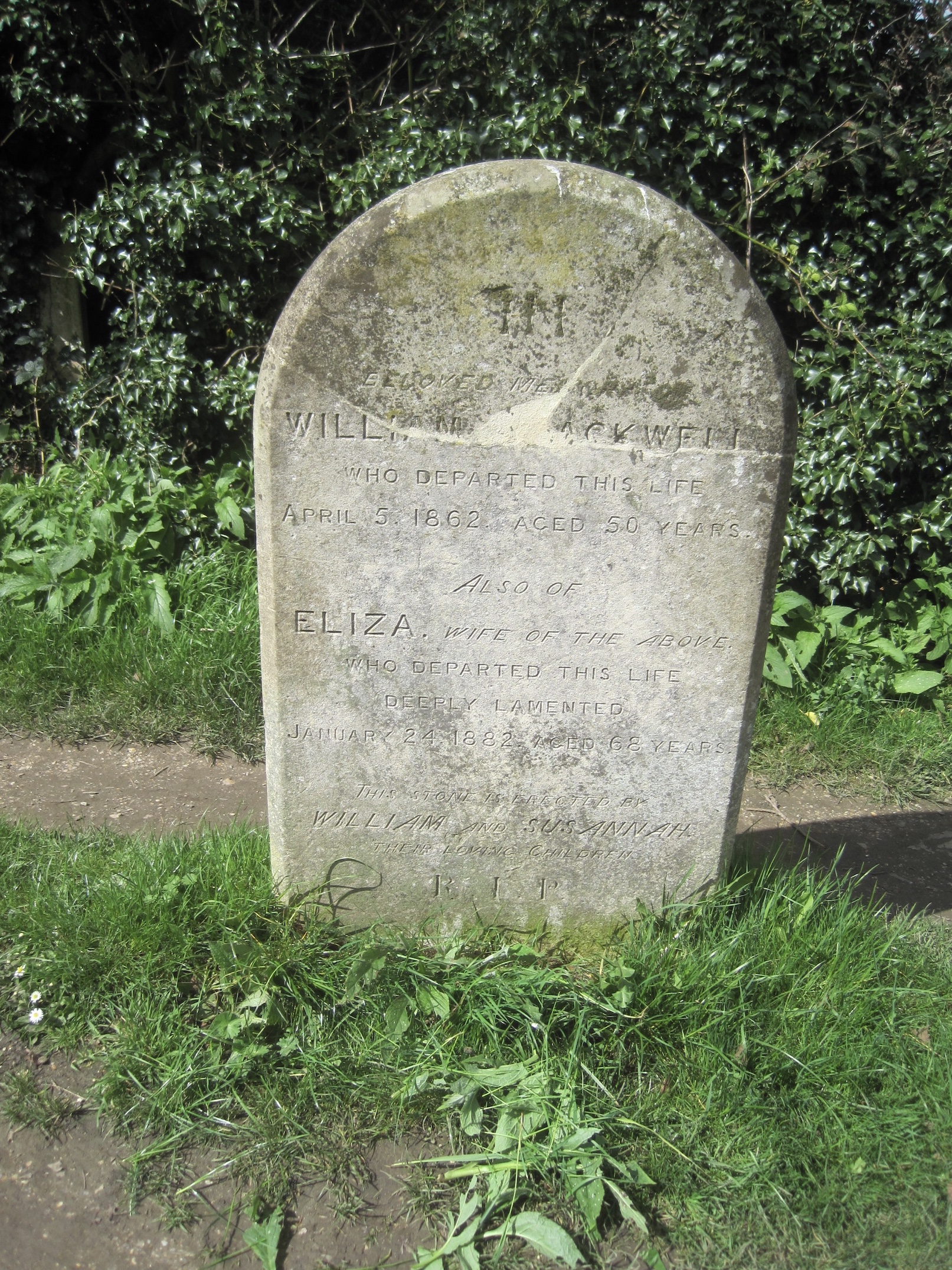
This headstone stands close to the west wall in the north of the cemetery, on the southern border of the parish of Andrew The Less.It has been repaired at some point. The carved inscription is still legible but the monument is often hidden by bramble.
Inscription
In Beloved Memory Of WILLIAM BLACKWELL Who departed this life April 5. 1862. Aged 50 years
Also of ELIZA. Wife of the above Who departed this life Deeply Lamented January 24. 1882. Aged 68 years
this stone is erected by WILLIAM & SUSANNAH their loving children
R.I.P.
William Blackwell (c.1812 – 5 April 1862)
William was born in Godmanchester, near Huntingdon and married Eliza Smart in Barnwell on 14 January 1834. The couple had at least four children: Edwin (1837-1901), Susannah (1844-), William Edward (1847-1892) and Eliza Smart (1850-1884). Edwin was born in Debden, Essex, the next two children in Edmonton, but the family had moved to live at 14 Staffordshire place, Cambridge by the time youngest daughter Eliza was born in 1850. William worked as a cattle dealer and the family later moved to Newmarket Road (at least 1855 onwards). In June 1855 he took farmer William Hardwicke to court for £7 owing for a cow. The two men had agreed to exchange cows, but when William’s cow was delivered to William Hardwicke, he rejected it on the grounds that it was lame. The cow was subsequently found to have ‘blane’ (a form of foot and mouth) and had to be treated by the vet. William Blackwell refused to accept the cow back, and instead sued William Hardwicke for the £7 which he said the cow was worth. William Hardwicke told the court ‘The cow was in a dreadful state when I received it, and I said I would have nothing to do with it, I did not know what to do with my cows, as the disease plaintiff’s cow, was infectious’. Various witnesses were called on either side. The judge found in favour of William Hardwicke and ordered William Blackwell to pay costs.
In May 1860 William and Eliza’s fifteen-year-old daughter Susannah was set to marry widower and grocer James Pretlove Offley (1832-1864) without the knowledge of her parents. If she was under 21 years old, then Susannah required the written permission of her parents, so James Offley instead declared she was 21 years old. Mr Cockerell, the town prosecutor tried to prevent the marriage by charging Offley with perjury for lying about Susannah’s age. William Blackwell told the court that although Susannah and James had known each other for some years he had not suspected anything between them until a few days ago. James Offley said he had not asked permission from Susannah’s parents as he knew they would refuse and so had stated on the marriage application that she was at least 21 years old. James was given bail upon payment of two sureties, but the marriage did however take place shortly after the trial, reportedly very much to the annoyance of William Blackwell. As James Offley was not ‘very prosperous’ they left Cambridge, with Susannah telling her parents they were heading for London. However, Susannah sent them a letter soon after, saying that the couple were in fact sailing for Australia. This chain of events was said to have caused William Blackwell much pain and ‘together with pecuniary difficulties, preyed upon (his) mind; but still nothing extraordinary beyond his usual conduct was observed; he attended to his business regularly, and showed no symptoms of insanity’. He did however fall behind with his rent and in April 1862 his landlord ‘entered a distress’ (enabling him to send in bailiffs to seize goods as security for payment of the debt). William Blackwell went to Mr. Sturton’s shop and purchased an ounce and a quarter of opium solution, telling the shop keeper it was to treat a pony. He then went home and drank the solution, before telling Eliza what he had done. Attempts to save his life were in vain, despite a doctor being called and his stomach pumped. He died twelve hours later, and an inquest was held into his death. Eliza Blackwell said that ‘he had never been the man since the marriage of their daughter to Offley some time back…ever since then, her husband had not been the same man; sometimes he went out by himself, and at other times he did not’. The inquest returned a verdict of that ‘deceased destroyed himself while in a state of temporary insanity’. He was buried at Mill Road Cemetery on 10 April.
Eliza Blackwell (née Smart) (c.1813 – 24 January 1882)
Little is known of Eliza’s early life, except she was born in Debden, Essex. No record has been found of her on the 1871 or 1881 census. She died at George Street and her funeral was held on 26 January.
Willliam and Susannah Blackwell who erected the grave monument for their parents both emigrated to Australia.
Sources:
Ancestry
Newspaper archives
Parish burial records transcribed by CFHS
by Claire Martinsen
[If you have any information about this family, please contact us at Friendsofmillroadcemetery@gmail.com