
CFHS code : AL395
Parish : St Andrew the Less
Inscription : ELIZA wife of ALEXANDER GOPSELL POOLEY d at Cambridge October 10th 1879 aged 53
Monument : Cruciform Coped stone
Above amended information from Cambridge Family History Society Survey
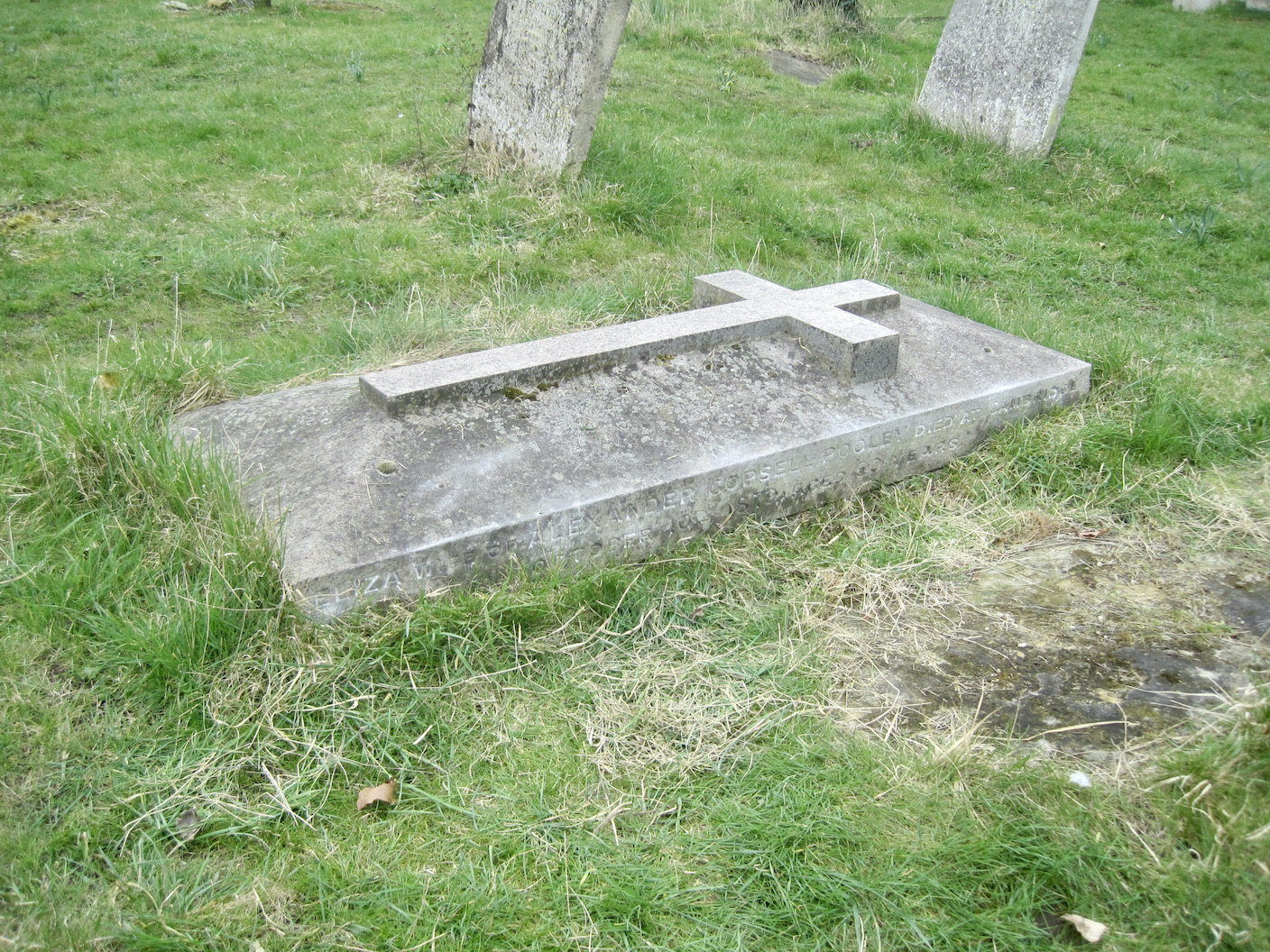
Monument
This cruciform coped stone in the parish of St Andrew the Less is just south of the north path and roughly 6 rows east of the central path. The carved inscription on the north side is still legible.
Inscription
ELIZA wife of ALEXANDER GOPSELL POOLEY died at Cambridge October 10th 1879 aged 53 years
Eliza Pooley (née Wingfield) (c.1826 – 10 October 1879)
Eliza was born in Northallerton (although later census records give her birth place as Datchet, Berkshire) and was the daughter of soldier James Wigfield (1775-), who served as an officer with the Queen’s Own regiment. Eliza was the second wife of Alexander Gopsell Pooley (1813-1886). His first wife Jane Wadbrook had died in 1846 and he had three children when he married Eliza (although no record of their marriage has been found). Alexander and Eliza had a further five children: George (1849-1924), Rodney (1850-1900), Charlotte (c.1856-1945), Alice Georgiana (1861-1909) and Harry Alfred (1862-1932). Alexander was described on some census returns as an iron merchant and on others as a west indies merchant and the family lived at 3 Cornwall Terrace, Lee near Greenwich (1861). By 1871 they had moved to live at 8 South Buildings in Clapham, and were documented on the census as having a housekeeper, kitchen maid, housemaid, cook and labourer to look after the family. However, Alexander was declared bankrupt several times during the marriage, and was no stranger to the courts.
In August 1859 he filed for bankruptcy and the Scotsman newspaper reported that he was ‘lately residing at 3 Cornwall Terrace…thereafter residing at Ardrishaig and now at Iveraray in the county of Argyle, Scotland – creditors meet in George Hotel, Inverary, 26th August at eleven o’clock’. His creditors amounted to £53,000 and the Glasgow Herald reported that he was just one amongst many English traders ‘who having repaired to Scotland and resided there for forty days acquired the requisite domicile to render him amenable to the Scotch Courts and became a Scotch Bankrupt’ (sic). Alexander was reported as being a manufacturing chemist and that his creditors had suffered considerable hardship. By being declared bankrupt in Scotland, the bankruptcy notice was not published in the London Gazette until the 23rd of August, and only gave his creditors 3 days to appear in Iverary. The Glasgow Herald reported that ‘of course it was utterly impossible for the creditors, who were unaquainted with the bankrupt’s movements to have matters so arranged as to admit of their being represented at the meeting’. The newspaper further noted ‘we cannot regard otherwise than with extreme suspicion the appearance of English bankrupts in remote districts of Scotland – where they are quite out of view of their creditors – for the purpose of taking advantage of the facilities afforded by the Scotch bankruptcy system’.
Alexander returned to live at Corwall Terrace, Lee but was declared bankrupt again in November 1862 in the English courts. He set up as a wine merchant with a son from his first marriage Thomas Alexander Pooley (1841-1904) and traded from Waterloo Place, but the partnership was dissolved in June 1866. He continued to trade as a wine merchant, located at Cloak Lane, London. In June 1870 Alexander was once more before the courts. He had leased the Alhambra Palace in Leicester Square from Sir Wiliam Foster for £22,500 in September 1864. Alexander Pooley agreed to pay a deposit followed by 12 installments to Sir William, but ‘became indebted to the Birmingham Banking Company…and gave to the bank as security for his debts an undertaking to assign to them his interest in the lease of the Alhambra but he never signed the mortgage deed’. Despite the bank alerting Sir William he completed with contract with Alexander Pooley, who then sold the lease at a profit to a Mr. Strange (who was also unaware of the claim of the bank). Alexander escaped punishment, and costs were ordered to be paid by Sir William.
Alexander later leased and ran the St. Aubin’s and St. Helier’s Railway, Jersey from Mr. W. Francis Cooper. He signed a lease from February 1878 for a three year period, but failed however to pay rent, and was sued for £960 for 48 weeks outstanding rent. In August 1879 Mr Cooper appealed to the High Courts in London to be appointed ‘manager and receiver of the said line’. Alexander however refused to give up the railway line, and the case went before the courts in Jersey on 23 October 1879. There were legal discussions about the court in Jersey hearing a case which was also being heard in the English courts. The Jersey Independent and Daily Telegraph reported that ‘as soon as Mr. Pooley knew that the receiver had been appointed he left London to avoid compulsion in the execution of the order. He fled to Boulogne and when served with a summons there, again disappeared’.
Eliza Pooley died in Cambridge aged 53 years old, and parish records show she died at Brunswick Place. She is thought to have come to Cambridge to live with her son George . A notice of her death was placed in the Jersey Independent and Daily Telegraph on 18 October 1879, but the place of death was not published, presumably so that he could continue to lie low.
In December 1879 Alexander Pooley was declared bankrupt once more and was said to be ‘late of the Queen’s Hotel, St. Martins-le-Grand, London, but now out of England’. He was eventually brought from Paris to London on a warrant on 1 June 1880. Alexander Pooley was imprisoned in Holloway as it was felt by lawyers ‘he was an old man, over 70 years of age and….longer imprisonment in Newgate would kill him’, In April 1881 Alexander was still a prisoner at Holloway but was later released.
In January 1883 Alexander was living at 30 Gloucester Crescent, Regent’s Park and was charged with ‘unlawfully consipring to cheat and defraud Mr. Robert Coulson’. Also accused was Alexander’s son Thomas Alexander Pooley and Mary Sophia Watson. A hearing was held but adjourned for a week as the evidence was ‘of a most complicated nature’. It is not known what subsequently happened in the case.
Alexander died ‘suddenly’ on 17 March at St. Peter’s Street, Islington. He was 73 years old and was buried at Highgate Cemetery on 18 March.
Alexander Pooley’s father led an equally colourful life. Dr David A Kennedy has written a fascinating account of his life which can be read here.
Sources:
Ancestry
Newspaper archives
by Claire Martinsen
[If you have any further information about this family, please contact us at Friendsofmillroadcemetery@gmail.com]