
CFHS code : AL359
Parish : St Andrew the Less
Inscription : In Memory of EDWARD R SANDERSON d Aug 15 1892 aged 68 also of ELIZABETH sister of the above d Jan 3 1880 also of EMMA wife of the above d Feb 2 1904 aged 75 also of LIZZIE TURNER
Monument : Headstone/Kerb stones
Above information from Cambridge Family History Society Survey
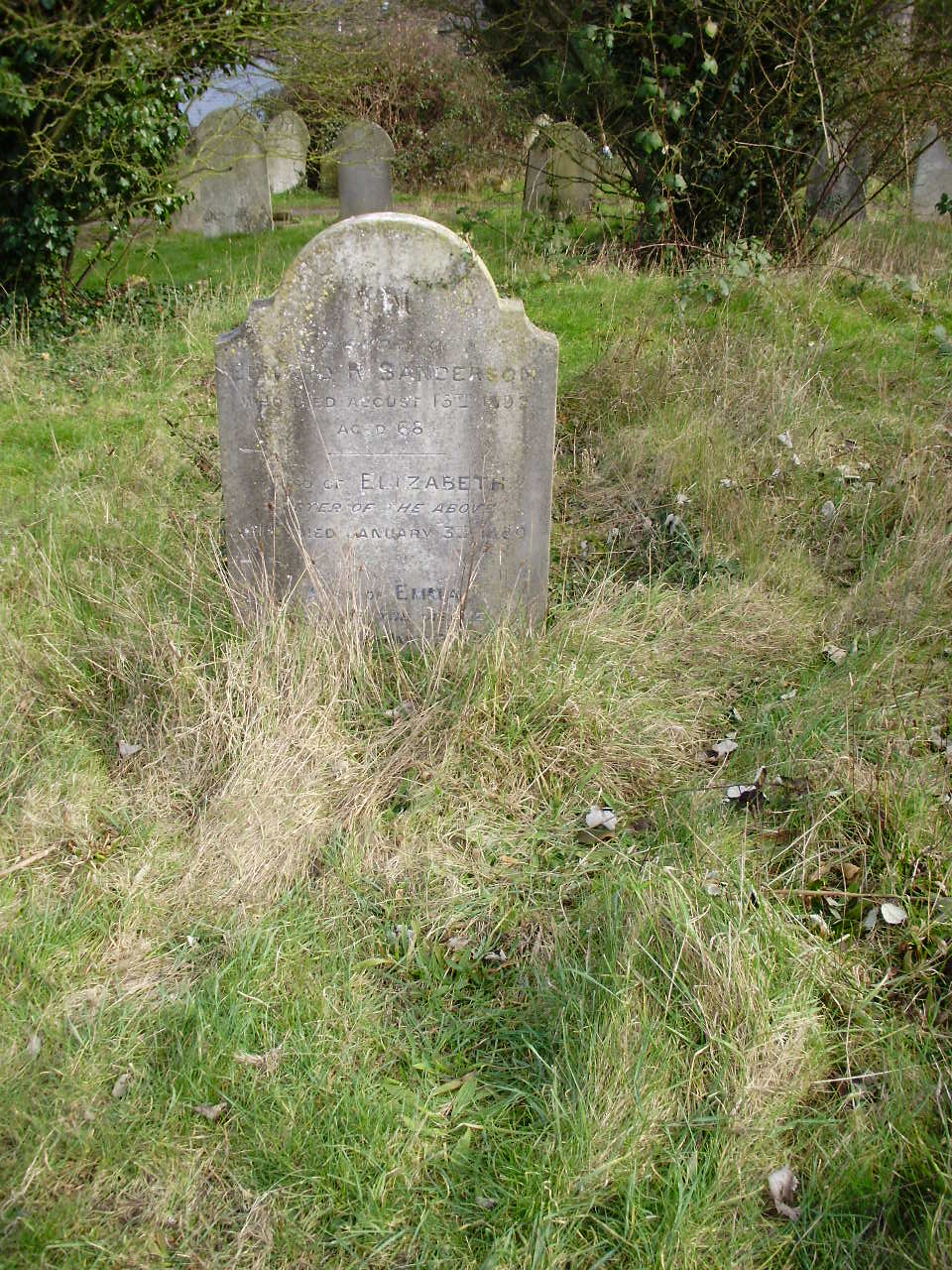
Monument
Inscription
Relationship: Husband, wife, husband’s sister and niece
Edward Rowell Sanderson (4 May 1825 – 15 August 1892)
Edward was the son of Richard and Sarah (née Gardner) and was born in Lambeth. The family had returned to Richard’s native Cambridge by 1827 and the family lived at White Hart Yard, King Street. His father was a carpenter, and his mother was a college bedmaker at Trinity College. His parents had many of their children baptised on a single day – 9 April 1846, including Edward who was 20 years old. In 1851 Edward was living at home and working as a labourer, and married Emma (known as Hannah) Rowlingson on 17 April 1854. In 1861 the couple were living at 2 Barber’s Court, King Street and Edward was working as a bailiff’s man, Hannah as a college servant. By 1871 they were living at 43 King Street with Edward’s sister Betsie and their niece Lizzie Sanderson. At that time Edward was recorded as a money lender.
In March 1876 Edward appeared at the High Court of Justice, as he was taken to court by barrister Frederick Harvey Linklater. Edward had unsuccessfully tried to sue Frederick in a Cambridge court, and he was now charging Edward Sanderson for damages to reputation for that previous court case. Frederick had borrowed money from Edward on two occasions whilst an undergraduate at Trinity College. The first debt was paid by his solicitor father in April 1869 who reportedly called Edward Sanderson ‘a disgrace to Cambridge’. Frederick’s father had paid the money believing that the college authorities would ‘send him down in case they knew of it’. Frederick then borrowed a further £37, 10s later that month ‘on a promissory note for £50 at six months’, telling Edward that he was hard up. The following month Frederick Linklater left Cambridge for India, married, and was called to the bar in 1873. Having not received payment Edward Sanderson issued a solicitor’s letter in November 1874 for the amount with interest at 5 per cent. Frederick’s case was that he was underage at the time the money was lent and therefore the loan was not valid. The court heard that Edward ‘was in the habit of lending money to young men at Cambridge’. Cross-examined Frederick admitted he had left Cambridge owing nearly £200 to small tradesmen across the town and these were still outstanding five years after his departure – ‘there are claims from bootmakers, hairdressers, tobacconists, fruiterers etc. I have not paid any of them since I left Cambridge. I do not dispute that these articles were actually received by me’. Frederick’s father James Linklater told the court Frederick had gone up to Cambridge with an allowance of £300 a year which he had thought ‘sufficient for his wants’. Edward told the court that he had risen from a labourer and now lent out money. He said ‘I have carried on the trade of money lending for 14 years. The only book I keep is a diary. The students at the University were my principal clients; but I lost nearly all my capital with them, and I have now clergymen and other persons – some of your own kind (i.e. judges). In 1868 and 1869 I lent money to the undergraduates. I know that the college authorities do not like the undergraduates to borrow from money lenders ‘. The judge at the trial was clearly very against money lenders and summed up saying that Edward carried on ‘a nefarious and scandalous trade. He had been described, and truly described, as a pest and nuisance of the place he inhabits’ and that he lent money to ‘young men liable to be carried away by the passions of youth, who have not learned from experience how to guard themselves from temptation’. The judge said he wished the University authorities had ‘some power to expel from its precincts such a pest and such a nuisance’. His summing up on the character of Frederick Linklater was not nearly as damming. Even Edward’s barrister in his speeches to the court almost apologised to Frederick Linklater for him having to bring the case to court. The jury took an hour to find in Frederick’s favour and he was awarded £100 in damages.
The couple moved to live at 28 New Square in 1876. In 1891 they were living there together with niece Lizzie, Lizzie’s husband Frederick Turner and their two infant sons, a monthly nurse and general servant Elizabeth Moden. In 1888 Edward was a major creditor of Ephraim Wayman, who was declared bankrupt, owing him £1,178 9s 8d. By 1891 Edward was no longer working and was documented as ‘living on own means’. He died at Camden House, Hunstanton and his funeral was held on 18 August 1892 at Mill Road Cemetery.
Elizabeth Frances (Betsie) Sanderson (26 March 1834 – 3 January 1880)
Betsie was Edward’s sister and was also baptised on 9 April 1846. She had an illegitimate daughter: Lizzie, who was buried in the same grave. In 1861 she was living with her parents, younger sister Sarah and Lizzie at 8 Trinity Place, King Street and was working as a dressmaker. She then lived with Edward and Emma at 43 King Street, where she was described as a companion (1871). She died at New Square and was buried at Mill Road Cemetery on 8 January.
Emma (Hannah) Sanderson (née Rowlingson) (c.1827 – 2 February 1904)
Hannah was born in Haverhill and was the daughter of Edward Rowlingson. After she was widowed she lived at New Square with Lizzie and Frederick Turner and died at home ‘suddenly’ aged 77 years. Her funeral was held on 5 February.
Lizzie Formby Turner (née Sanderson) (1855- 30 March 1936)
Lizzie was the illegitimate daughter of Betsie Sanderson. She was baptised on 10 February 1856, and her mother’s name was given as Elizabeth Frances Rowell Sanderson (which is slightly different to the name Betsie was baptised with). She grew up with her grandparents and then with Edward and Emma Sanderson. Lizzie married Frederick William Turner in 1888 and they had two sons: Edward Attack (1889-1967) and Ben Cecil (1891-1951). They lived with Edward and Emma at 28 New Square, and in 1891 Frederick was working as a solicitor’s clerk. By 1901 the family were still at New Square, living with widowed Emma Sanderson, but by this time Frederick was no longer working as was ‘living on own means’.
Frederick Turner died on 12 January ‘from the effects of exposure’ and an inquest was held into his death. A policeman found him at 1am on the steps of the ‘public convenience at Hyde Park Corner. Witness thought he was drunk and asleep, and tried to rouse him. The man got up, but seemed unable to walk, so witness sent for the ambulance and conveyed him to the Police Station’. Frederick was placed next to a fire and said he had a pain in his stomach. Dr Lucas was called and found that he was suffering from exposure, so gave him a ‘strong stimulant’. Despite the doctor’s efforts he died an hour later. The post-mortem found ‘the deceased’s heart, liver, kidney and lungs were badly diseased. He had pneumonia of the left lung, and that caused death’. The doctor told the inquest that the post-mortem had also showed signs of chronic alcoholism and that this had contributed in part to his death. The inquest jury returned a verdict of death from natural causes.
Lizzie later ran a Lodging House from 13 Brunswick Place (1911) and died at home aged 80 years old.
Sources:
Ancestry
Newspaper archives
Parish burial records transcribed by CFHS
by Claire Martinsen
[If you have any information about this person, please contact us at Friendsofmillroadcemetery@gmail.com]