
CFHS code : AL540
Parish : St Andrew the Less
Inscription : Sacred to the Memory of ELIZABETH the beloved wife of ROBERT WALTON d June 9th 1867 aged 55 also of the above named ROBERT WALTON d Jan 4 1877 aged 73
Monument : Headstone
Above information from Cambridge Family History Society Survey
Lat Lon : 52.2037154514953, 0.13733860757195
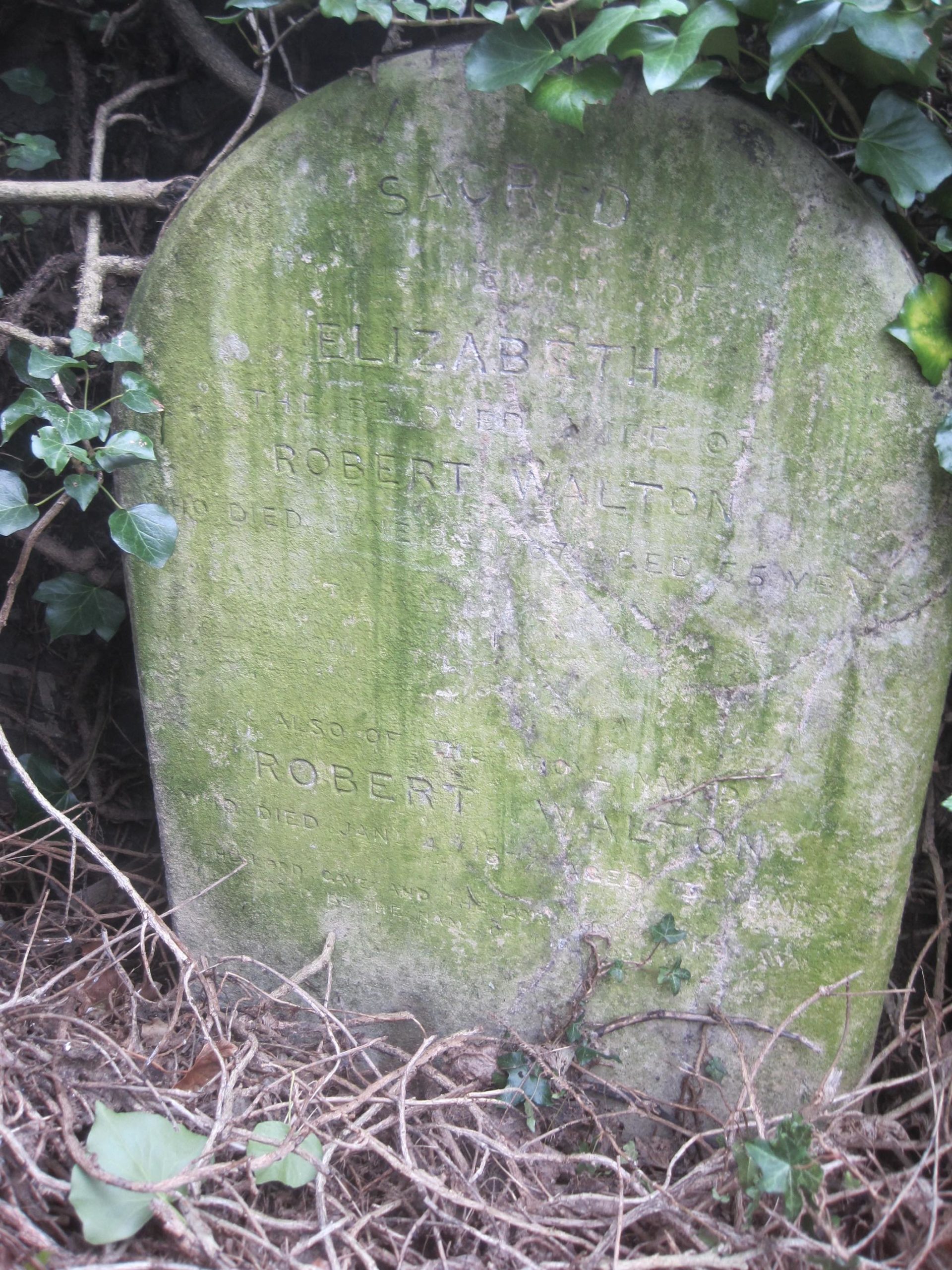
Monument
From the Norfolk Street gate, against the west wall in the far north of the cemetery.
Inscription
Sacred to the Memory of ELIZABETH the beloved wife of ROBERT WALTON who died June 9th 1867 aged 55 years
4 lines illegible
Also of the above named ROBERT WALTON who died Jan 4 1877 aged 73 years
“The Lord gave and the Lord hath taken away
Blessed be the name of the Lord”
Elizabeth Walton (née Purser)(1812 – 9 June 1867)
Elizabeth was born in Warwickshire, the daughter of gardener Robert Purser. From c.1836 she lived with Robert Walton at the Jolly Ragman pub, East Road. Robert was married, and the two lived as man and wife, until he was widowed, and they married officially on 27 April 1859 at St. Andrew’s Church, Holborn. They had at least six children: Alfred (1836-1784), Sarah Ann (1842-1911), Harriet (1844-1924), Robert (1847-1905), William (1848-1907) and Elizabeth (1849-1860). Elizabeth died at East Road, and her funeral was held on 13 June.
Robert Walton (1802 – 4 January 1877)
Robert was the illegitimate son of Mary Whitehead and was born in North Aston, a village in Oxfordshire, 7 and a half miles south of Banbury, and ten miles north of Oxford. He was baptised there on 27 June 1804. On a later marriage certificate he gave his fathers name as gardener Robert Walton, and this might explain why he was given the surname Walton at baptism, rather than Whitehead. He married Caroline Augusta Cummins (1802-1853) on 19 August 1827 in Southwark. They lived in Lambeth and had at least six children: Charles Robert (1828-1903), Emma (1830-1832), George (1830-1915), Emma (1832-1907), Henry (1833-1867) and Caroline Eliza (1834-1837). Robert ran a Marine Store, which was a form of rag and bone store. Marine dealers were licensed brokers who bought and sold used timber, metal, rags, and other general waste materials. However, the marriage appears to have broken down, and by at least 1838 he was living in Cambridge with Elizabeth where he ran the Jolly Ragman.
In 1844 he charged John Myers with having stolen £5, 18s from him. John had come to lodge at the Jolly Ragman, and when he left the next day Robert noticed the purse containing the money had disappeared. P.C. Morgan found Myers in Bridge Street, and he had the missing items in his possession. Elizabeth gave evidence at the trial, and she was described as his housekeeper. At trial John Myers pleaded guilty and requested to be transported (presumably to Australia) as he was a ‘discharged Irish soldier and incapable of getting employment’. The court did not grant him his wish, and he was sentenced to twelve months in jail with hard labour instead.
By 1847 Robert had diversified and was also running a ‘bone manure’ business. In 1857 he was given the lease of five acres of land off Coldham’s Common for coprolite digging – the rent ‘being 100l, 10s per quarter, and for every ton above 134 raised within the quarter, 15s. Not more than two acres to be dug at the same time. All the land to be dug to the depth of 12 feet. Leasee to remove within the term any mill he may erect’. Coldham’s Common was a lucrative location with large deposits of coprolite, and Robert Walton was one fo the first entrepreneurs to commercialise the industry, as described in this article. In April 1858 the agreement with the Council to dig for coprolite on Coldham’s Common was renewed and extended. The new terms were for seven actres at a rent of £130, 10s per quarter and 15s per ton for every ton exceeding 174 dug within the quarter. In 1863 Robert’s son Henry was called to testify in the case of waterman Edward Dockerill, against Mr Cain, lessee of the water toll at Clayhithe. Cain had attempted to charge Edward 3p per ton [payable on goods, wares or merchandise], whereas Edward had only wanted to pay 1p per ton on the cargo he was carrying for Robert Walton [payable on manure or limestone]. Henry Walton explained that the coprolite was ‘ground very fine, and mixed with acid, superphosphate of lime is produced, and used solely for manure. He was not aware that coprolites are used for any other purpose than manure. There is no refuse which is used for any other purpose and he did not know of any use to which such refuse could be put’.
In 1871 he was living at 85 East Road with son William and servant Maria Laws. Robert was described on the 1871 census as a general dealer, but he was also described as a manure manufacturer and farmer. Adverts in local newspapers advertised ‘nitro-phosphate and blood manure…dissolved bones and super phosphate of lime’. The company was run from two Bone and Manure works, located at East Road and Coldham Road.
In July 1872 Robert’s worker Alfred Gilbert was charged with stealing between 80 and 90 lambskins from Robert’s house, and selling them on to marine dealer Alfred Moseley, who was alleged to have known they were stolen. Alfred Gilbert pleaded guilty, but was given a lenient sentence as Alfred Moseley was believed to have been the more guilty party. Gilbert received a total of 4 and a half months hard labour, and Moseley six months hard labour.
Robert died at East Road and was buried with his wife four days later.
Sources:
Ancestry
Newspaper archives
Parish burial records transcribed by CFHS
by Claire Martinsen
Robert and Elizabeth’s daughter in law Caroline Walton is also buried at Mill Road Cemetery
With many thanks for RW, great great great grandson of Robert Walton for additional information
[If you have any information about this family, please contact us at Friendsofmillroadcemetery@gmail.com]